AI Governance for Rural Electric Cooperatives
The AI Your Co-op Is Adopting Could Expose Every Operational Gap You Already Have.
Many co-ops deploy AI into operations that aren't ready for it. Inconsistent workflows, governance gaps, and cybersecurity exposure don't disappear — they amplify
AI adoption is rapidly entering:
outage management,
load forecasting,
field dispatch,
predictive maintenance,
grid analytics,
and member-service operations.
Explore the SONAR™ Framework →
Executive AI Governance & Readiness Assessment for Co-ops
AI Is an Amplifier
Deploying AI into unprepared operations doesn't fix problems — it exposes and amplifies them.
AI magnifies whatever is already in place. Well-run operations get more efficient. Fragmented ones get more unstable.
If your workflows are inconsistent, your governance is weak, or your data isn't clean — AI won't solve that. It will make it harder to manage faster.
Anyone who's watched a technology rollout go sideways, this isn't a warning. It's a pattern. The fundamentals have to be solid before AI enters the system — or the cracks get bigger, not smaller.
Who We Help
If you run operations, manage a crew, sit on a board, or carry accountability for a co-op's grid reliability
— this is for you.
Steam Powered Consulting works with rural electric cooperatives and member-owned utilities: executive leadership, board members, grid and field operations leaders, and the operational teams who actually have to make AI work on the ground.
We don't work with investor-owned utilities or tech vendors. Our focus is co-ops — the people who built careers on reliability, not hype.
Schedule an Executive AI Readiness Discussion
Vendor-neutral. No software to sell. Just a straight assessment of where your co-op stands.
We help cooperatives govern AI adoption before operational instability, cybersecurity exposure, workforce disruption, and fragmented execution create systemic risk.
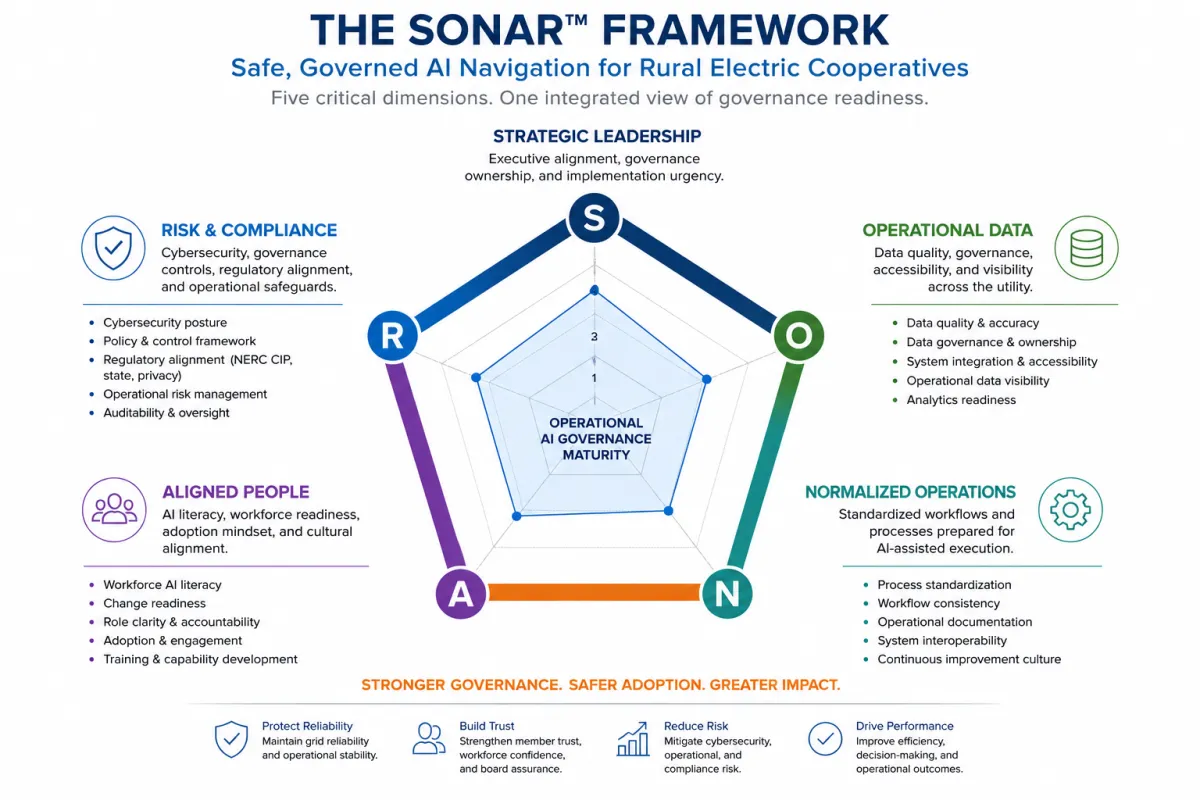
The SONAR™ Framework
Safe, Governed AI Navigation for Rural Electric Cooperatives
AI implementation does not fail because of technology.
It fails because organizations attempt to deploy AI into environments lacking:
leadership alignment,
operational readiness,
governance maturity,
workforce adoption,
and operational safeguards.
S — Strategic Leadership
Executive alignment, board visibility, governance ownership, and implementation accountability. AI without leadership ownership stalls or drifts.
O — Operational Data
Clean data, outage visibility, GIS coordination, and operational telemetry. AI is only as good as the data feeding it.
N — Normalized Operations
Standardized outage response, dispatch coordination, and maintenance workflows. Consistency in operations is what makes AI-assisted execution possible.
A — Aligned People
Workforce readiness, team adoption, and the human side of AI integration. Technology doesn't run itself — your people have to be ready for it.
R — Risk & Compliance
Cybersecurity safeguards, NERC CIP considerations, governance controls, and operational risk oversight. Know your exposure before you deploy.
Why Vendor-Neutral AI Governance Matters
Most AI vendors have one objective: get deployed. Their incentive is implementation speed, not your operational readiness.
Steam Powered Consulting doesn't sell software. We don't have an implementation platform to push. That means when we assess your co-op, we're evaluating what actually matters — operational readiness, governance maturity, cybersecurity exposure, workflow consistency, and organizational risk — before you commit capital or operational dependency to anything.
Co-ops deserve a straight assessment before the sales pressure starts. That's what we provide.
No vendor agenda. No software pitch. Just an honest look at where your co-op stands.
From Readiness to Transformation
SONAR™ tells you where your co-op stands on AI governance readiness.
CATS™ — the Corporate AI Transformation System — is what comes next. It helps cooperatives operationalize governed AI transformation through structured implementation, workforce alignment, leadership accountability, and operational safeguards. [Learn about CATS™ →]
Frequently Asked Questions
Q1: What is AI governance for rural electric cooperatives?
AI governance is the set of policies, accountability structures, and operational safeguards that determine how a co-op adopts and manages AI tools. It covers who owns AI decisions, how risks are managed, and how AI integrates with existing grid and field operations — before deployment begins, not after.
Q2: What is the SONAR™ Framework?
SONAR™ is Steam Powered Consulting's AI governance readiness framework for rural electric cooperatives. It evaluates five areas: Strategic Leadership, Operational Data, Normalized Operations, Aligned People, and Risk & Compliance — giving co-op leadership a clear picture of where they stand before committing to any AI implementation.
Q3: Why do utility AI projects fail?
Most utility AI projects fail because the organization wasn't operationally ready before deployment. Inconsistent workflows, weak governance, misaligned leadership, and unprepared workforces don't get fixed by AI — they get amplified. Technology isn't the problem. The environment it's deployed into is.
Q4: Why is operational readiness important before AI deployment?
AI performs based on the quality of the systems and data it operates within. A co-op with fragmented workflows, inconsistent data, or unclear accountability structures will see those problems get worse when AI enters the picture — not better. Readiness assessment prevents that.
Q5: What risks can AI create for electric cooperatives?
AI deployed without governance can increase cybersecurity exposure, amplify existing operational inconsistencies, create NERC CIP compliance gaps, and disrupt workforce stability. For co-ops managing critical infrastructure, these aren't theoretical risks — they're operational liabilities.
Q6: Why does governance matter in utility AI adoption?
Without governance, AI adoption defaults to vendor timelines and IT project management — neither of which accounts for the operational, workforce, and compliance realities of running a rural electric cooperative. Governance ensures leadership owns the process and the risk.
Q7: Why is vendor-neutral governance important?
AI vendors are incentivized to accelerate deployment. A vendor-neutral advisor has no software to sell and no implementation timeline to hit — which means the assessment is based on what's right for the co-op's operations, not what moves a vendor's deal forward.
Q8: How should co-ops evaluate AI readiness?
Co-ops should evaluate readiness across five areas: leadership alignment, data quality and accessibility, workflow consistency, workforce preparedness, and cybersecurity posture. An honest assessment of these fundamentals — before any vendor engagement — is the difference between a successful AI deployment and a costly one.
Steam Powered Consulting
AI Governance Consultancy
© Steam Powered Consulting 2026 All Rights Reserved.